
Monarchs and Migration: Children at the BoA̶rder of Freedom by Consuelo G. Flores is Self Help Graphics & Art’s 2026 Día de Los Muertos Commemorative Print
Self Help Graphics & Art’s 2026 Día de Los Muertos Commemorative Print is Monarchs and Migration: Children at the Boarder of Freedom, by Consuelo G. Flores. This serigraph is dedicated to children who came to the U.S. seeking freedom but ultimately died in detention in U.S. Border Patrol centers.
Regarding the print, Flores says, “The focus of this print is on the children featured and the potential that was lost when they died in the hands of Border Patrol custody. This is a call back and reminder to our immigrant past, of the many transplants from other countries, of my own siblings who entered this country as children.”
The children depicted, left to right, are Juan de Leon Gutierrez, Wilmer Josue Ramirez Vasquez, Anadith Danay Reyes Alvarez, Carlos Gregorio Hernandez Vasquez, Marlee Juarez, Felipe Gómez Alonzo, and Jakelin Caal. All of the children depicted came to the United States from Central America seeking asylum, and from 2018 to 2023 died under Border Patrol custody from both preventable and completely treatable illnesses like the flu, respiratory, sinus, and bacterial infections, and pneumonia.
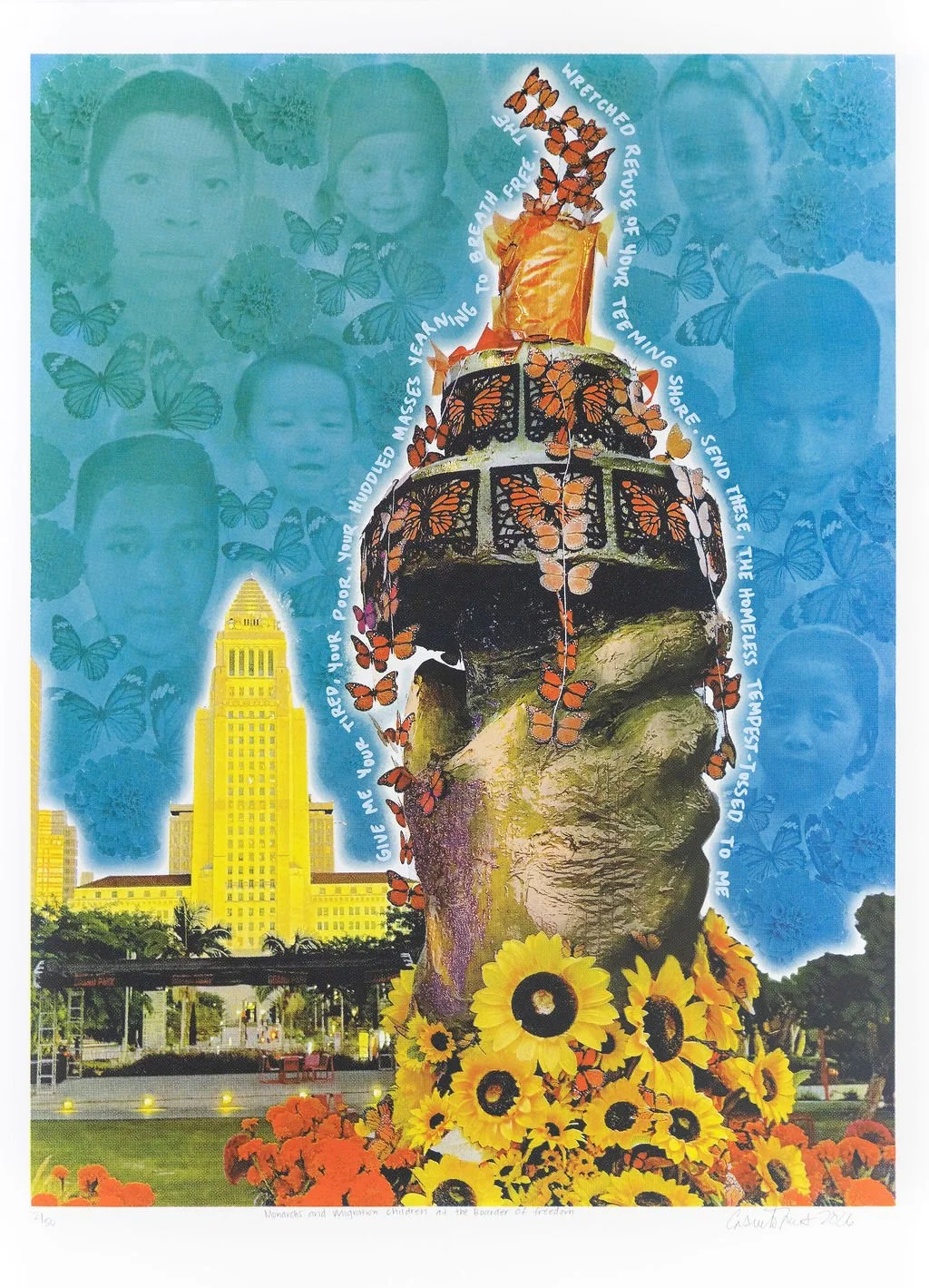
Consuelo G. Flores, Monarchs and Migration: Children at the Boarder of Freedom, 2026
Screenprint, 26.5” x 20” sheet, Artwork photograph by Eric Jaipal
Note: This year’s Día de los Muertos Commemorative Print ships in September.
Order before October 1, 2026, and receive a free Día de los Muertos shirt or tote bag with your purchase.
“All of these children that are in the background…you can see them, they’re like little angels,” Flores says. “It was important to honor these children because they were babies…I could not just not honor these kids.”
For her, the work is grounded in both grief and outrage. “It’s horrifying enough that they died in Border Patrol custody. But they died from the flu. They died from completely preventable illnesses, completely treatable illnesses. So, the fact that they were allowed to die - that is murder.”
When they witness the piece, she’s asking viewers to look more closely, to move beyond the surface. “When viewers view my print, first of all, I want them to think it’s beautiful, with the colors and everything. And then I want them to study it. And then I want them to see the faces of those children.”
That act of looking is central to this work. Flores shares, “I want people to understand that…these were children who were smart. Who knew who they were.” She wonders, “Who could they have been? What would they have brought?”
In sharing this piece, her intention is not only to honor the children lost, but also to activate us. “I want people to be horrified after it sinks in and I want people to be mobilized to…do what you can do to stop this madness and really uplift our communities. I’m honoring these children because I don’t want people to forget them.”
At the same time, she holds space for healing. “I want to uplift our community, which has been so wounded. I want us to recognize our wounds, but I don’t want us to lose hope and I don’t want us to use the pain of those wounds for anything but….fighting off this horrible attempt to erase us.”
Born and raised in East Los Angeles, Flores’ relationship with Self Help Graphics began when she was 19. After encountering Califas: An Exhibition of Chicano Artists in California, a 1981 exhibition at UC Santa Cruz (where she was studying as an undergraduate), she returned home and met Sister Karen Boccalero, SHG’s founder. “If she saw passion in you, if she saw ‘know-how’ in you, if she was able to recognize skills and abilities, she gave you free rein over what you could do at Self Help. Whatever she saw in you, she supported.”
Soon after, Flores became co-director of SHG’s gallery, curating exhibitions and producing events while immersing herself in Día de los Muertos traditions. What began as research became something deeper through practice. “Self Help Graphics was the birthplace of my cultural awakening,” she shares.
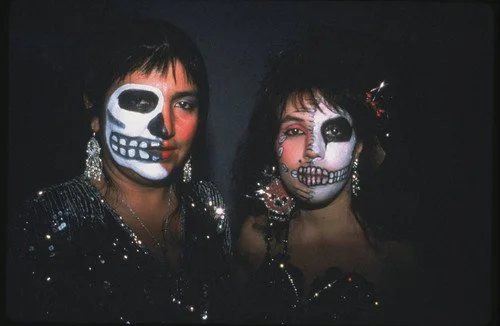
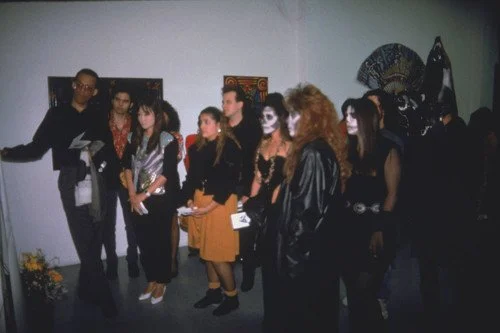
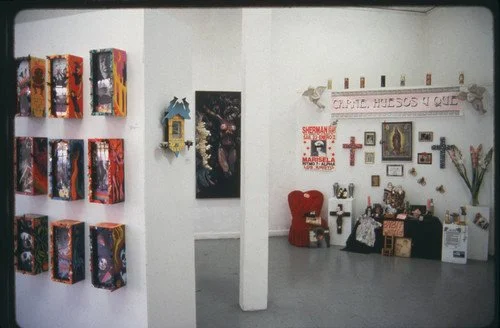
Día de los Muertos Exhibition at Self Help Graphics in 1989. 35mm slides courtesy of the California Ethnic and Multicultural Archives at the University of California, Santa Barbara
Although Flores has been part of the SHG community for more than 45 years, this is her first serigraph produced in the Professional Printmaking Studio. She made it in collaboration with Dewey Tafoya, Self Help Graphics’ Lead Printer, and Gabby Claro, SHG’s Studio Assistant.
Inspired by a photographic approach, she set out to create a print that would function like an altar - just like the 2025 Día de los Muertos Community Altar that she created at Gloria Molina Grand Park, honoring immigrants who have been persecuted in the United States.
That altar featured a papier-mâché Statue of Liberty torch filled with monarch butterflies and cellophane, rising from a bed of sunflowers and marigolds. Thousands visited the installation, leaving over 500 notes—messages of remembrance, migration stories, and expressions of solidarity. Her daughter-in-law Omega Norte took a photograph of it and her son Alain Flores Norte helped with the design of the print, adding photos of children who have died while in Border Patrol custody in the background, surrounded by marigolds and monarchs.
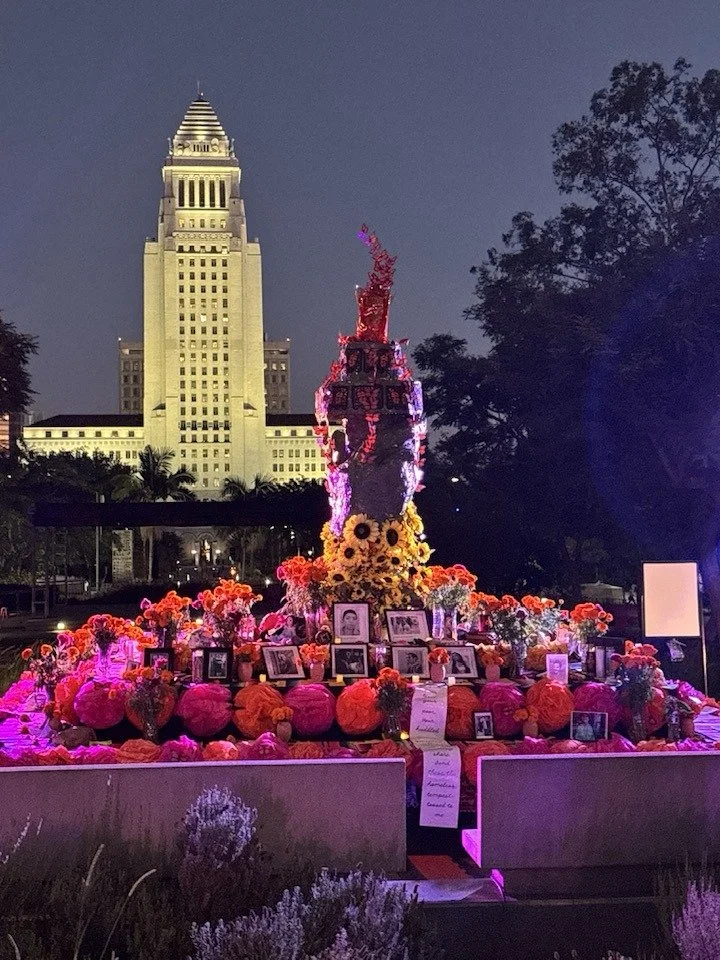
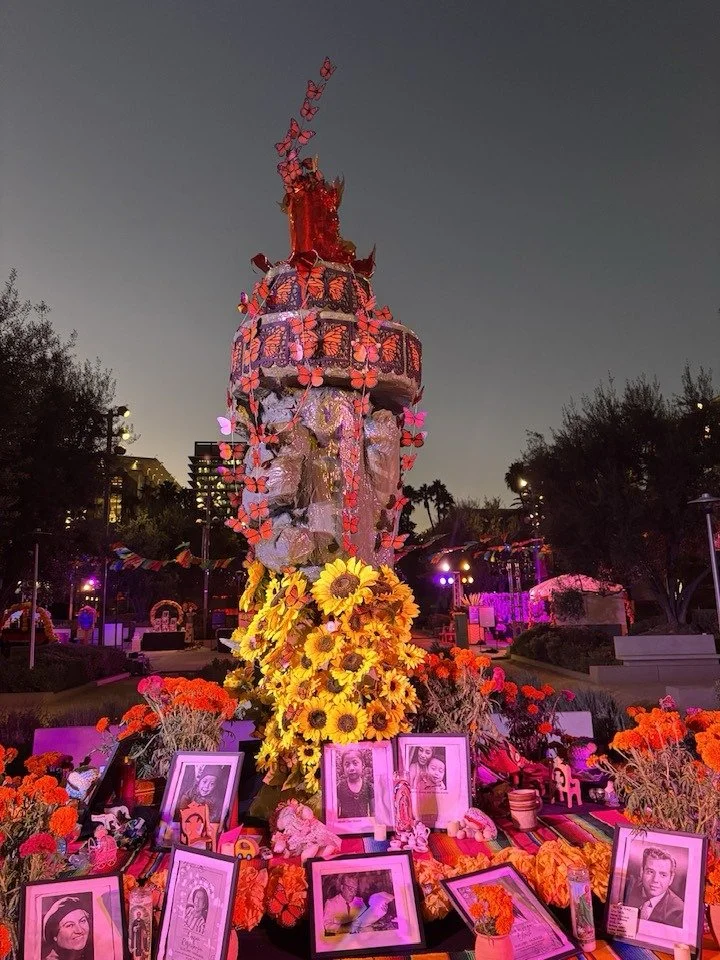
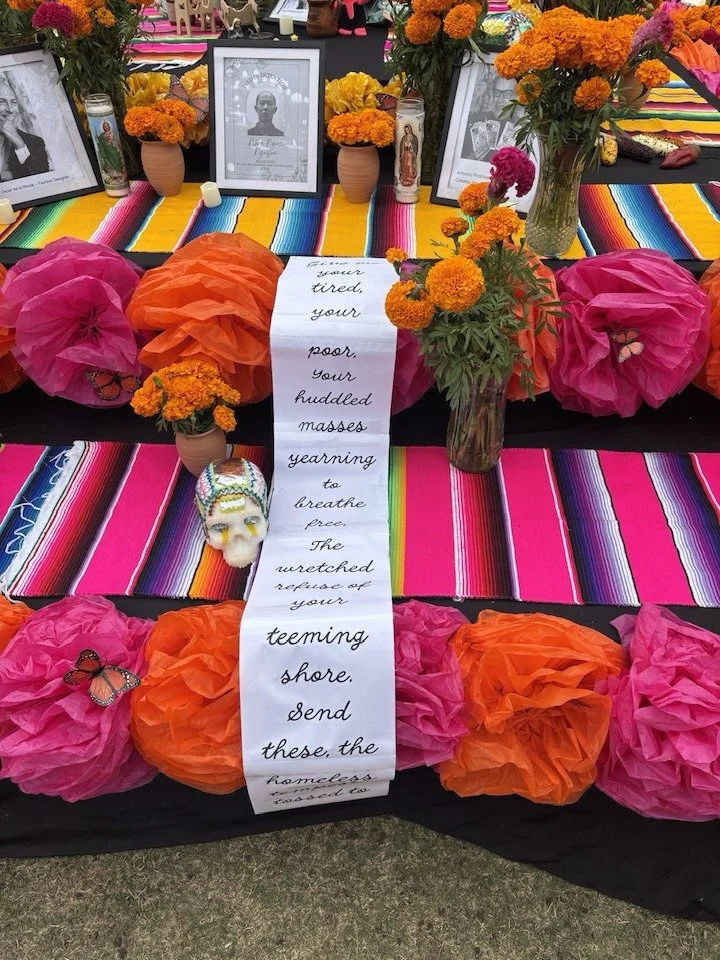
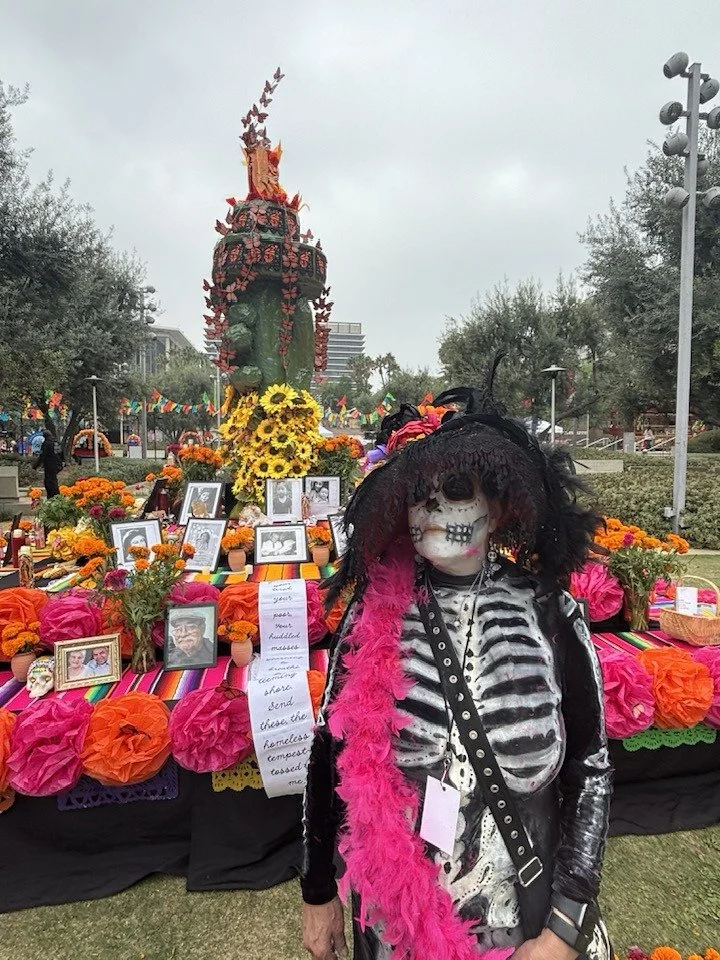
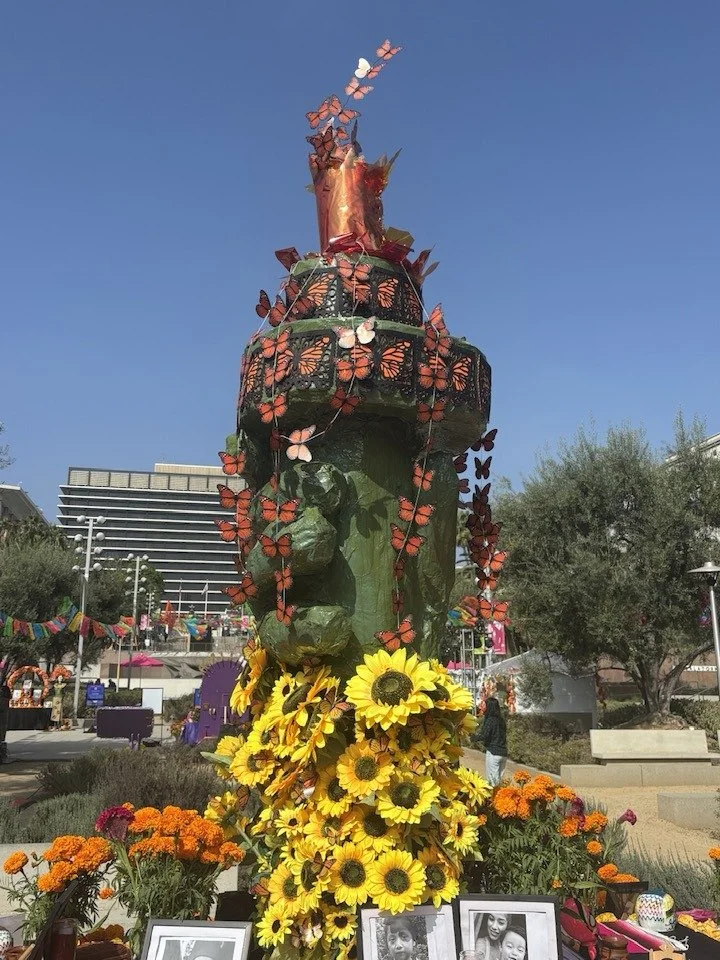
Day of the Dead Community Altar by Consuelo G. Flores at Gloria Molina Grand Park in 2025. Photos Courtesy of Stephen Blackburn.
Flores says, “The sunflowers represent the Native American soil on which the Statue of Liberty stands and is a reminder that unless you or your ancestors are Indigenous to this land, or your ancestors were brought as enslaved people, everyone here is an immigrant.
The stories of immigrants reflect tragedy, resilience, fortitude, love, and ultimately hope. The monarch butterflies represent migration and that hope immigrants of all backgrounds strive for – of a metamorphosis from struggle to success, in the land of opportunity. Migration is part of nature, part of the human spirit. Migration is to explore, to survive, to seek shelter and create a better life.”
For Flores, even the text of the title holds meaning. The word “boarder” is marked with an “X,” underscoring that the children are no longer “boarders” in detention—they died there.
Ultimately, Flores invites us to spend time with her piece —to study it, to unpack its layers, and to look closely at the faces of these young and completely innocent children who had both their freedom and their young lives taken from them.
To learn more about the process behind Consuelo’s print, we invite you to check out the video below:
THE STORIES OF THE CHILDREN HONORED IN THE PRINT
Carlos Gregorio Hernandez Vasquez
Carlos Gregorio Hernandez Vasquez, an ambitious 16 year old athlete and musician, traveled from San Jose del Rodeo, Guatemala to the United States by bus with his sister, eventually crossing the Rio Grande River and arriving near Hidalgo, Texas, where they were detained by Border Patrol agents. He was taken to an overcrowded processing center in McAllen, Texas on May 13, 2019, where he was diagnosed with the flu. By May 19, 2019, he had a fever of 103 degrees. There, the nurse practitioner recommended that he be checked on in two hours, and if his condition did not improve, he should be taken to a hospital. Instead, he was moved to a cell for quarantine in Waslaco, a Border Patrol station, so he would not infect others. The next morning, he was found dead by his cellmate. ProRepublica acquired a video of Carlos’s last hours in the cell, which contrasts with the press release shared by the Customs and Border Protection regarding this tragedy. Viewer note: the video shows Carlos’ suffering, which was exacerbated by the negligence of the CBP officers.
Marlee Juarez
Yazmin Juarez and her 17 month old baby Marlee Juarez traveled from Guatemala to the United States in search of safety and better opportunities. They were detained and transferred to a Customs and Border Protection facility, where they were locked in a cage, referred to by many as an “ice box”, with 30 migrants. They were then taken to the South Texas Family Residential Center in Dilley, Texas, where baby Marlee was found to be healthy. However, Yazmin remembers that a lot of the children at that detention center were sick, and six weeks later, Marlee got a respiratory infection. Marlee was given over the counter medicine, antibiotics, and was eventually taken to a hospital, where Jazmin was not even allowed to hug or hold her daughter. Marlee spent her last days on a ventilator, and died on May 10, 2018, when she was just 19 months old.
Juan de Leon Gutierrez
Juan de Leon Gutierrez’s hometown of Camotán, Guatemala had undergone a drought, affecting the maize, bean, and coffee fields he worked in, limiting the area’s already scarce economic opportunities. On April 14, 2019, 16 year old Juan traveled from Guatemala to the United States with a coyote, hoping to reunite with his brother, who had undergone a similar journey in 2011, with the goal of supporting his family with remittances. He was detained on April 19, 2019, and then sent to a migrant youth shelter in Brownsville, Texas, where he died on April 30, 2019, following a surgery meant to relieve a Pott’s puffy tumor, which is usually caused by an untreated sinus infection or head trauma.
Wilmer Josue Ramirez Vasquez
Two year old Wilmer Josue Ramirez Vasquez and his mother were detained by Border Patrol agents on April 3, 2019, near the Paso del Norte International Bridge in El Paso, Texas. This bridge is a temporary outdoor detention center with no adequate infrastructure, just a chainlink fence. Migrants that are held there sleep on dirt floors and are exposed to cold and windy nights. Wilmer got sick three days later and was taken to Providence Children’s Hospital in El Paso, where he was hospitalized for approximately a month, until he died. He had been diagnosed with pneumonia.
Felipe Gomez Alonzo
Agustin Gomez Perez traveled to the United States from Guatemala with his oldest son, eight year old Felipe Gomez Alonzo, seeking asylum as a way to escape the extreme poverty in Yalambojoch, located in the municipality of Nentón, in the department of Huehuetenango, Guatemala. In order to undergo this arduous journey, Agustin took out a loan. Many community members from his rural hometown had crossed the border with their children, convincing Agustin that the same would be possible for him and his son. After being detained by Border Patrol mid-December 2018 in El Paso, Texas, Agustin and Felipe were taken to many holding facilities in New Mexico and Texas which were known for their terrible conditions such as dirt floors and overcrowding. Shortly thereafter, young Felipe developed a fever, a sore throat, and congestion due to a staph infection in his lungs. He eventually developed sepsis. Upon hospitalization, he was erroneously diagnosed with the common cold, and was given medication and released. Just hours later, he died from complications of an influenza B infection with Staphylococcus aureus superinfection and sepsis shortly before midnight on December 24, 2018.
Jakelin Caal Maquin
Seven year old Jakelin Caal Maquin and her father Nery Gilberto Caal Cuz, both from a Mayan Qʼeqchiʼ Indigenous community in Alta Verapaz, Guatemala, traveled to the United States in December 2018, seeking asylum. They were detained by Border Patrol near New Mexico’s border on December 6, 2018. Hours later after being placed in a bus, Jakelin was feverish and was vomiting. Once they arrived at a Border Patrol location, she was seen by medical staff. Hours later, she suffered from seizures and a fever of 105.7°F. This prompted her flight to a hospital in El Paso, Texas, where she died the next day. An autopsy report concluded that the cause of death was Streptococcal sepsis, which had spread to her liver, lungs and other organs.
Anadith Danay Reyes Alvarez
Mabel Alvarez Benedicks traveled from Mexico to the United States, arriving near Brownsville, Texas, on May 9, 2023, with her husband and their three children. One of them was eight-year-old Anadith Danay Reyes Alvarez, who was born in Panama. Anadith had chronic heart conditions and sickle cell anemia—an immunocompromised condition that requires constant medication, which Mabel had documented and shared with officials upon arrival. Anadith was diagnosed with the flu shortly after entering U.S. custody. The family was then taken to a Border Patrol facility in Harlingen, Texas, where young Anadith woke up with a fever and pain in her bones. Mabel requested her daughter be taken to the hospital but agents said her flu diagnosis did not require hospital care. Her symptoms got worse. She received some medication but she still had breathing problems, a sore throat, and couldn't walk. After being detained for eight days in Border Patrol facilities, Anadith’s body went unconscious and she died.
ABOUT THE ARTIST
Consuelo G. Flores is a Los Angeles-based writer, multidisciplinary artist, and cultural worker best known for her deep involvement in Día de los Muertos (Day of the Dead) cultural practices, theater, poetry, and community arts education. She has played a significant role in promoting and interpreting Mexican and Chicana/o cultural traditions through both artistic and educational work.
Flores is recognized for her writing, poetry, playwriting, and performance work. She holds an MFA in Creative Nonfiction from Antioch University, Los Angeles. She actively engages in cultural education and community art, especially focused on Día de los Muertos. This includes building altars (ofrendas), writing “Literary Altars,” and teaching about the cultural and historical significance of the celebration.
Flores has written and directed plays and been involved with theater companies, including producing works at festivals like the Frida Kahlo Theater, Brisk, and Fierce Backbone play festivals. Her play Soul Sacrifice, about the impact the Vietnam War and the protest against it had on a Mexican American family in East Los Angeles, will have a four-week full production run at Casa 0101 in Boyle Heights from May thru June 2026. She’s been published as part of a unique writing collective of women whose book of threaded poetry An Illegal Feast was released in July 2025 through Broadstone Press. Their second book Carnivores And Other Lovers will be released in late summer 2026 through the same publisher.
*** Self Help Graphics recognizes that the "A" in boarder is capitalized on certain web pages - this is a web coding technicality due to an inability to feature strikethrough letters on certain platforms, not a misspelling.