
Shop Merch & Prints
Please note that during our building renovation print sales will temporarily take 30-45 days to process and ship from the date of purchase.
Check-out tips:
For all questions regarding your online orders, please email info@selfhelpgraphics.com.
If you receive a message that “quantity is low” upon checking out, simply close the pop-up and proceed to your cart.
At checkout please choose the “Standard Format Print Shipping” shipping option, if the incorrect shipping option is selected you will receive an email prompting you to adjust your order.
Please note that during our building renovation print sales will temporarily take 30-45 days to process and ship from the date of purchase.
Shop Gifts
Here are a couple of items in the collection.
Click the link below to shop the entire collection.

Sinks: Places We Call Home is the official catalog for the 2024 exhibition curated by Marvella Muro and presented by Self Help Graphics & Art (SHG) at the Luckman Gallery at California State University, Los Angeles, as part of the Getty's Pacific Standard Time initiative, Art & Science Collide. This interdisciplinary exhibition catalog features essays by curators, scientists, and researchers on various topics, including environmental justice, community engagement and advocacy, visual arts, and mineralogy. Sinks presents research-based works by artists Maru García and Beatriz H. Jaramillo that examine environmental justice through art and social practice, The exhibition focuses on two case studies of contamination in South, South East and East Los Angeles along a toxic corridor of contamination linking black and brown communities. The first is the former Exide battery plant in Vernon and the Athens Tank Farm in Willowbrook, which have left toxic legacies on surrounding neighborhoods. Artists Maru García and Beatriz Jaramillo present new works rooted in community research. García collaborates with the Los Angeles County Natural History Museum (NHM) to conduct soil testing and lead reduction research with community scientists in East and South East Los Angeles, while Jaramillo engages with the Willowbrook Community Garden through workshops that explore nature, art and healing. The catalog is edited by Luke Aleckson and includes essays by Marvella Muro (SHG), Dr. Aaron Celestian (NHM), Ana Guajardo (SHG), Lila Higgins (NHM), James MacDevitt (Cerritos College), Laura Pulido (University of Oregon), and Sam Tayag (NHM), and highlights the advocacy of a multitude of community members and organizations, offering diverse perspectives on art, science, and environmental justice.

Be a part of the 50th Anniversary of SHG and show your support by grabbing one of our new t-shirts!

Self Help Graphics & Art is proud to present Kalli Arte’s Sueños Real exhibition catalogue. Kalli Arte’s Beyond the Press culminating residency exhibition is on view July 23-September 23, 2022. Calli or Kalli (home in Nahuatl) is central to the collective's art practice and the focal point of the exhibition.
Paying homage to the cultural ecosystem that is Boyle Heights, the exhibition will be grounded by a symbolic installation of the artists’ home. This central sculpture will connect like roots and branches, to various images of elements, people, and iconographies that are core to their creative practice and family unit.
The exhibition catalogue features serigraph prints, photography, and artworks included in this vibrant exhibition at Self Help Graphics & Art, with an introduction by Marvella Muro, SHG’s Director of Artistic Programs and Education.
The soft-cover catalogue features serigraphy, photography, and hand embellished artworks developed by the artists.
8×10 in, 20×25 cm.
# of pages: 48

The Donut (W)hole exhibition pays homage to the Cambodian immigrant and Cambodian American (Khmerican), the aftermath of warfare and genocide, stories of survival, determination, and commitment to the family unit. It also highlights a celebration of the Cambodian stories told through the lens of 1st and 2nd generation Khmericans who grew up in their family's donut shops. These donut shops represent a cultural space where refugees and immigrants reshape their lives in the process of negotiating, assimilating, and becoming American.
The exhibition catalogue features illustrations of the drawings and silkscreen prints included in this poignant exhibition at Self Help Graphics & Art with an introduction by scholar Dr. Jaspal S. Sandhu (UC Berkeley and Founder of Pint Box Stories) and essay by Artist and Scholar, Phung Huynh.
The soft-cover catalogue features essays, paintings, drawings and fine prints.
5x8 in. (13x20 cm).
# of pages: 52

The Shell in the Clouds (El Caparazón en las Nubes or Ma' Conch't do't Nub't) softcover book is a visual documentation of Pavel Acevedo's printmaking process and the body of work created during his Beyond the Press residency at Self Help Graphics & Art. "The images created in this series are a celebration of the rebelliousness that is part of ourselves," says Pavel Acevedo.
The artist's work includes an array of mythological characters inspired by the Zapotec stories, in a contemporary context, shared by his grandfather to explore migration, immigration, borders, and the duality many immigrants contend with after leaving their homeland for a new nation. The pages are filled with otherworldly creatures, half-human half-animals (nahuales), and highly detailed work, leading viewers from one page to another.
This softcover book features printmaking art and photography.
Size: 8×10 in. (20×25 cm).
# of pages: 48.
Shop Featured Prints
Here are a couple of items in the collection.
Click the link below to shop the entire collection.

Ester Hernandez
Rosie, La Pachuca, 1944, 2023
Serigraph, ed. Of 60
30 x 19 in.
Rosie, La Pachuca (an image inspired by a 1944 photograph) is part of the artist’s family/ her story that honors our free-spirited, rebellious Xingona ancestors. Ester celebrates their ability to adapt and recreate themselves with a lot of style and attitude that inspires us today.
Que Viva Las Xingonas!!!

Amina Cruz
Cyclona, 2024
Serigraph, ed. Of 50
30 x 22 in.
Amina Cruz's work stems from a deep interest in investigating the areas between transformation and identity, personal narratives, and how inhabited spaces shape individuals. Cruz is an interdisciplinary artist who primarily uses photography as a form of exploration. They surrender to materials and collaboration as tools to investigate visual representations and forms of identity.
The artist uses the camera lens to tell stories from a queer and brown perspective, disrupting the consumption of bodies and conquering of territory. It allows for an openness to what wants to be seen. Their brownness provides for an intuitive relation. They recognize and are cautious of their position as the photographer and, thus, producer of representation.
Cruz is interested in art that enables viewers to connect more deeply with the preciousness and complexities of a changing self and the in-between moments that question purpose and belonging.

Jackie Hernandez "Chicas Peligrosas"
Entre Los Angeles (Between Los Angeles), 2024
Serigraph, ed. Of 60
30 x 22 in.
Self Help Graphics & Art
Entre Los Angeles (Between Los Angeles) highlights the experience of going out to shows with friends and expressing themselves through fashion, music, and community regardless of people's disapproval, including parents.
In regards to this serigraph, the artist says, “The Pachucxs' resilience and attitude are the principal inspiration behind this work—their unapologetic way of being themselves despite adversity. The Pachucxs, with their unwavering determination, have been an enormous influence and inspiration to different Chicano subcultures within Los Angeles, one specifically being the punk scene, especially in East LA. When the punk movement was not welcomed in popular LA venues to play shows, they created spaces in their backyards and neighborhoods.”

Jaklin Romine
Roses Easter Sunday on Display (Rosas Domingo de Pascua en exhibición), 2025
Serigraph
30 x 22 in.
Roses Easter Sunday on Display is an homage to the artist’s grandmother, Gloria Ernestine Romine Hernandez, a strong willed, no-nonsense, woman that shared her love with her family. Born in the 1930s and raised in Lincoln Heights, Los Angeles, Gloria lived in a household raised by a single mother and five siblings. Forced to become independent at an early age, Gloria and her siblings earned a living working in the orange fields in the summertime, and as a kid, she made her own clothes.
Growing up and into her older years, Gloria never identified as a Pachuca. White passing, she never experienced the racism that others in her community faced, therefore, navigated life by blending in and stirring the ground to the minimum.
However, her attitude as a passive observer changed witnessing her older sister’s abusive partners and more specifically, when she became a mother in her 20s, as she witnessed her children experience the racist banters because of their dark complexion. Her passivity shifted, becoming a protective force for her family, and through fashion, a passion she always carried, she created embellished suits that celebrated her cultural pride, deepening her connection to her roots.
Roses Easter Sunday on Display is a glimpse of Gloria’s royal grandeur as seen through the artist’s eyes, and memorializing women’s strength and perseverance.

Janeth Aparicio Vazquez
llano en llamas (Burning Plains), 2024
Serigraph, ed. Of 50
30 x 22 in.
In 1973, Mexican writer and Nobel prize laureate Octavio Paz published the essay "El Pachuco y Otros Extremos" (Pachuco and Other Extremes), one of the first literary analyses of Pachuquismo to Mexican audiences. While Paz criticized “El Pachuco ha perdido toda su herencia: lengua, religión, costumbres, creencias” (the Pachuco has lost all its heritage: language, religion, customs, beliefs), he also described pachuques (the act of being a pachuco) as rebeldes instintivos (instinctive rebels).
Contrary to Paz's judgment of the Mexican-American subculture, the artist believes this rebeldía instintiva is pachuquismo's significant inheritance from working-class relatives. Llano en Llamas (Burning Plains) places pachuquismo as part of a legacy of movements of resistance. Reflecting on the work by scholars Nydia A. Martinez and Santamarina Gómez and referencing Juan Rulfo's Llano en Llamas, the print connects the rebeldía instintivo of Pachuquismo to the rebeldía alegre (cheerful) of the Zapatistas, and the rebeldía that lives in each working-class person affected by the industrialization and extractive capitalism of post-revolution Mexico. Llano en Llamas also records Popocatepetl's volcanic activity from the sky in February 2024.

Melba Martinez
Stay Strapped, 2024
Serigraph, ed. Of 50
30 x 22 in.
Through the work Stay Strapped, the artist Melba Martinez interrogates what self and community safety look like for brown queer bodies. With fascism on the rise, Martinez revisits the Pachuca as a symbol of protection for themselves and the people surrounding them, allowing the artist to bring forth different aspects of their practice together. The artist transformed herself into a tough-as-nails character through makeup, costume, and props, mirroring her resilient communities and their relentless fight against oppression. While playing with double entendre to bring a layer of lightness and comedy to the piece, Stay Strapped embraces the Phrase, “Not gay as in happy, but queer as in FUCK YOU!”
Shop Prints
from 2010-2020
Here are a couple of items in the collection.
Click the link below to shop the entire collection.

Phung Huynh
Our Voices Count, 2020
Serigraph, Ed. of 60
26”x20”
As a refugee who was not born in the United States, I have always had a complex relationship with government documents. I struggled with trusting a government that has had a long history of discrimination, racism, and anti-immigrant policies. I also realize that I was granted asylum and a permanent place of residence in Los Angeles where I can safely reconstruct a life that is more than just survival. Through a vibrant network of family, friends, social justice as well as arts and culture communities, I have found a place where I belong and where I can call home. I am an artist, mother, and educator, and I feel that it is important for me to advocate for the census, especially in contributing to the efforts to make sure that the most vulnerable and underrepresented sectors of our city are counted.
The people I have chosen to include in my print form a collaborative portrait of family, friends, colleagues, and those who stand in solidarity for equity and inclusion. The faces are half-toned, blue impressions on a bright orange gradation. They are the faces of Sidney Weiner, my oldest son who is mixed race (an identity that still has no appropriate box to check). Rick Noguchi is my partner who is committed to the mission of the Japanese American National Museum which preserves the history of Japanese American concentration camps as a conduit to speak out for social injustices. Dr. Sherri Rodriguez is a vice president, and Dr. Llanet Martin is a dean at Los Angeles Valley College, a community college in Los Angeles County where I teach in the Art Department. They both are incredible women of color in leadership who serve disproportionately impacted students, which include Black scholars, veterans, foster youth, and Dreamers. Finally, Sergio Teran is my chosen brother, a brilliant Latinx artist and art professor who continues to inspire and innovate with his life’s work.
The words on the print are simple and underscore the tone of the message in that every person counts, our voices count, and what we say matters. Representation matters and inclusive representation matters more.

April Bey
Blanca 1996, 2020
Serigraph, Ed. of 60
26”x20”
Blanca 1996 is part of the Make It Count, Census themed-atelier. It depicts a portrait of Blanca Maldonado, a DACA student (Dreamer) with the body from an ad in which a white woman appropriates the fashion of Frida Kahlo.
The expression, "I will not be assimilated" comes from the series Star Trek, where the alien species called The Borg (part humanoid and part computer) invade worlds and assimilate the people into their collective, thereby erasing all culture and individuality. Right before The Borg destroys a civilization, they announce their presence by saying, "We are the Borg, you will be assimilated."
The work is a defiant stance against feeling vulnerable due to society and oppressive laws that dictate who is worthy of being counted or not.

Martha Carrillo
We All Count, 2020
Serigraph, Ed. of 60
26”x20”
For the Census themed atelier titled, Make It Count, Martha Carrillo created a jovial and celebratory 8-color print, with the message of inclusivity. She focuses on the LGBTQ community, children, and women of color.
A firm fist at the forefront, with a pencil at hand, is ready to complete the census form while a bright rainbow radiates from its fingers. The artist’s two close friends, punk rock icon, Alice Bag, and artist Shizu Saldamando, are depicted symbolizing strong women of color and the creative community. They hold Shizu’s baby, reminding viewers to include infants in the Census- the most underrepresented demographic in the previous Census counts.
Image of two coquettish figures, inspired by an old photograph, flamboyantly pose wearing bright red lipstick and heels. Both look confidently at the viewer, representing the LGBTQ community in the heyday of the Civil Rights movement with pride. The image comes together elegantly, framed with orange California poppies- a resilient and adaptable flower.

Alvaro D. Marquez
Your Presence Counts - Tu Presencia Cuenta, 2020
Serigraph, Ed. of 60
21.5”x34”
Marquez’s map-based print of Southern Los Angeles County, possibly the south bay where the artist lived. The Spanish ships, scattered tent encampments, and police cars reference colonialism, homelessness, and policing. Your Presence Counts is a message of empowerment specifically to the communities of color in the fight against the social, economic, and political oppression. These are the same oppressions that augment the number of homeless victims and decrease all sense of stability.

Dalila Paola Mendez
Weaving Stories of Resilience, 2019
Serigraph, Ed. of 30
11”x15”
This huipil (woven blouse) is a woven story about the determination and resilience of Central American migrants who traverse 1,000s of miles in the hope of creating a better life for themselves, their families, and their children. As asylum seekers weave new stories of hope, they also deal with the crazy realities of violence, imperialism, and colonialism. This huipil honors the children and families that risk everything for a better future. Itis a woven story of resilience, determination, and freedom.
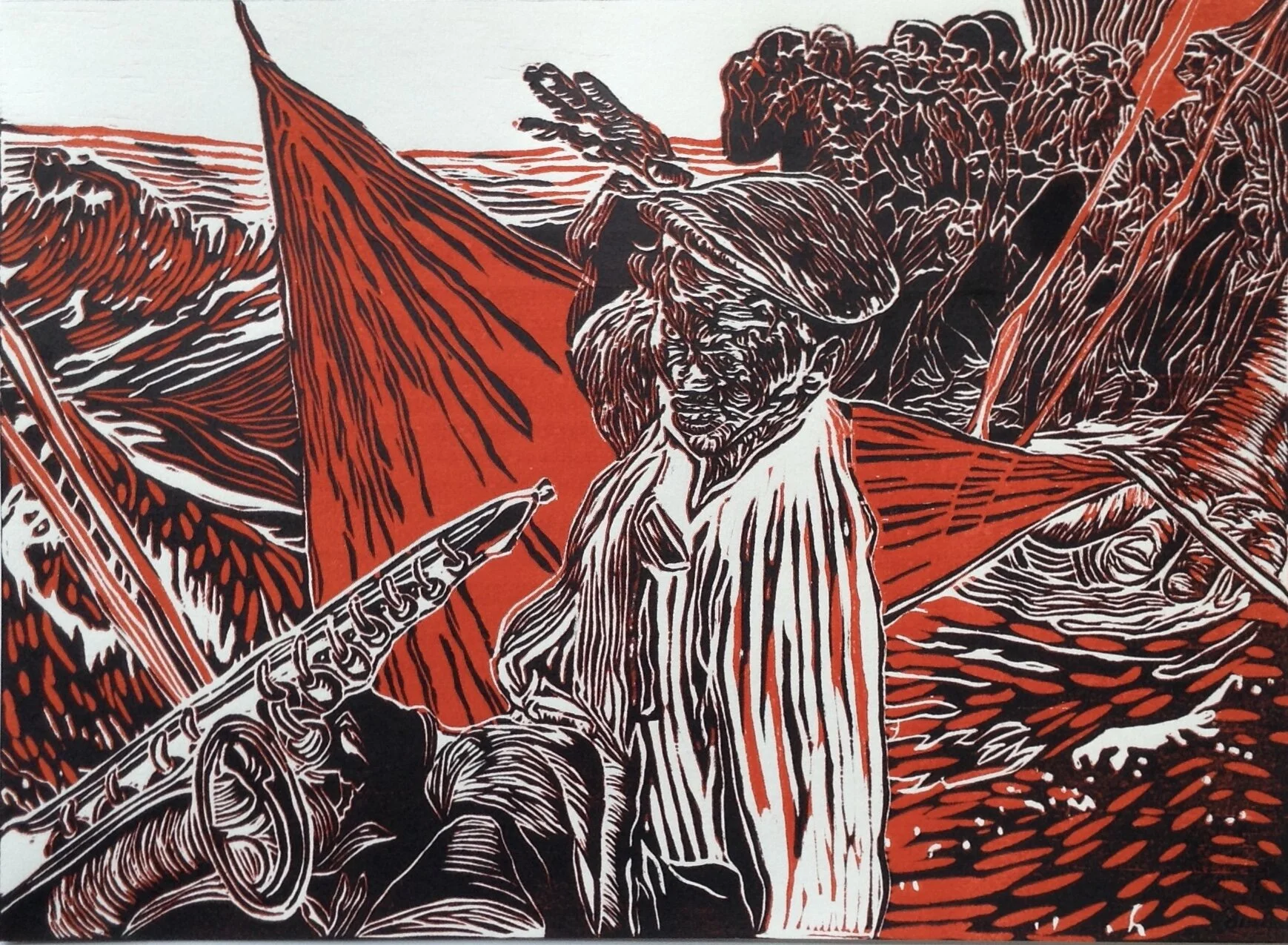
Phumelele Tshabalala
Bridging the Borders, 2019
Woodcut, Ed. of 30
11”x15”
For Raw World, I created Bridging the Borders; a two-color woodcut print, printed in black and red oil-based inks on white Fabriano paper. Each print has a central figure, with figures in motion in the background. This image reflects a scene I witnessed in one of my favorite spaces downtown LA. The process of creating this print began with compositional sketches collaged from photographs that I have taken, found imagery collected from newspapers, magazines and online.
Depicted in this print is an extremely talented saxophone player that I have encountered in the fashion district in DTLA. The clothes on his back and the saxophone are the only things this man owns. He joyfully plays this instrument for us as we pass by. Through his playing he builds a bridge between himself and us; introducing us to his world. This is a world or experience that I often contemplate as a hopeful immigrant encountering others like him in the streets, buses and trains. In this moment I witnessed us being transformed by his melodies. People like him courageously live their lives by robustly navigating the often-challenging raw experiences of their daily life, whether or not their earthly vessels allow them to or not. I am often challenged by their grit and strength. They teach me humility, they inspire me, and they are beautiful mirrors.
This work is created to honor them and to deliberately reflect on our times. I am committed and dedicated to going beyond mere formal questions of making art. In creating artworks, I aim straight at the heart of who I am? what is going on around me? And what can do or say to make a difference? I firmly believe in art that is not just an expression of individual satisfaction however a conceptually/technically belligerent and educative art for all.
Shop Prints
from 2000-2009
Here are a couple of items in the collection.
Click the link below to shop the entire collection.

Barbara Carrasco
Tina Modotti, 2008
serigraph, ed. 74
26 x 20”
signed and numbered

Melanie Cervantes
Rigoberta Menchu, 2009
serigraph, ed. 80
26 x 20”
signed and numbered
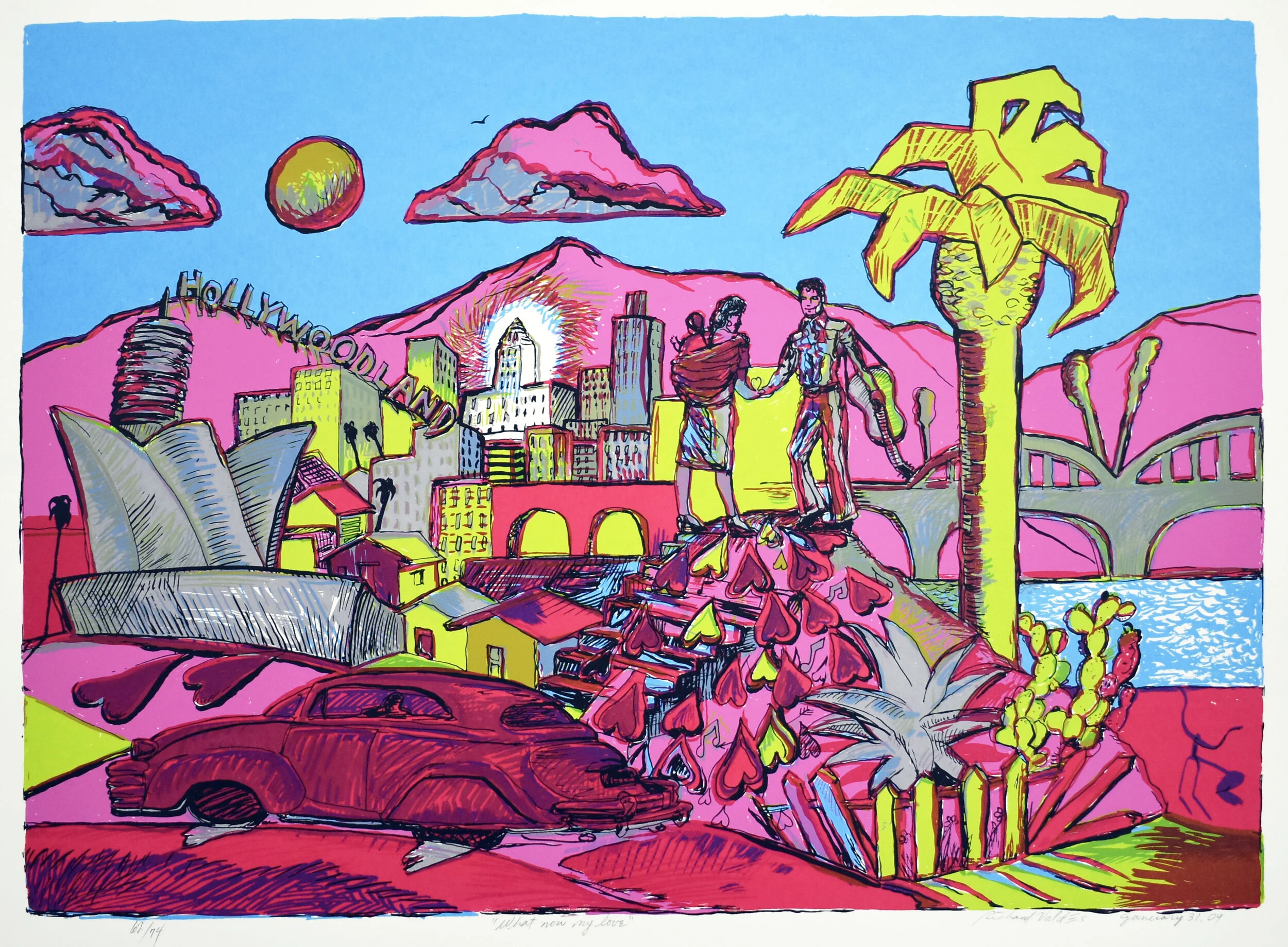
Richard Valdez
What Now My Love?, ca. 2009
serigraph, ed. 74
20 x 26”
Signed and numbered

Tanner Goldbeck
Red 22, 2009
Serigraph, Ed. 80
26”x20”
The large, yellow and red skull, filled in with line details and dot patterning, jumps out of the blank background in an almost three dimensional effect. Working in the skateboard, motorcycle, and extreme sports industry for years, Goldbeck was interested in translating the skull iconography ubiquitous in these industries into fine artworks. Though the skull is an icon with myriad different cultural and religious significations, Goldbeck aimed to draw a more visceral reaction with this work. The skull’s intense brick red color, and wicked, terrifying facial expression invest the image with a sharp potency that leaves the senses jolted, and perhaps even unnerved.
Tanner Goldbeck lives and works in downtown Los Angeles. Originally from Baltimore, he received a BFA from the Maryland Institute College of Art. A current member of the Los Angeles Art Association, his work has been shown in solo and group exhibitions around Los Angeles for over a decade. A self-described, “dedicated line junkie” His work is an evolving struggle between control and spontaneity that reflects his sense of identity and his relationship with the environment. He finds energy and influence in the conflict, harmony and cadence of daily life downtown.

Jose Ramirez
Las Tres Reinas, 2009
Serigraph, Ed. 189
11”x14”
Jose Ramirez has, as an artist, illustrated children’s books, painted murals and completed commissions for numerous organizations and individuals. He has taught in LAUSD for over 23 years and is currently teaching 3rd grade at Esperanza Elementary in the Pico-Union neighborhood of Los Angeles.
He received a BFA (1990) and an MFA (1993) in art from UC Berkeley. In 1995, he received a California Teaching Credential from CSULA. In 2001, he received the California Community Foundation Visual Artist Fellowship. In 2017, he completed commissions for Chapman College, South Pasadena’s Eclectic Music Festival, and Trejo’s Tacos (Pasadena). He worked with Altamed, National Immigration Law Center, National Day Labor Organizing Network, California Wellness Foundation, Inner City Struggle, Community Coalition and Self Help Graphics. His work was exhibited at the Mexican Cultural Institute in Washington DC, Avenue 50 Gallery in Highland Park and Homegirl Café in Los Angeles. His paintings were featured on the CBS TV show, The Good Fight. He is currently working on a children’s book about the life of Carlos Santana, for Atheneum Books.
Shop OPS
Prints
Here are a couple of items in the collection.
Click the link below to shop the entire collection.

Jose L. Zuno
The turtle, the rabbit, and the elephant man
Dry point etching done on a zinc plate
Ppr Size: 14 13/16" x 11"
Img Size: 11 11/16" x 8 5/8"

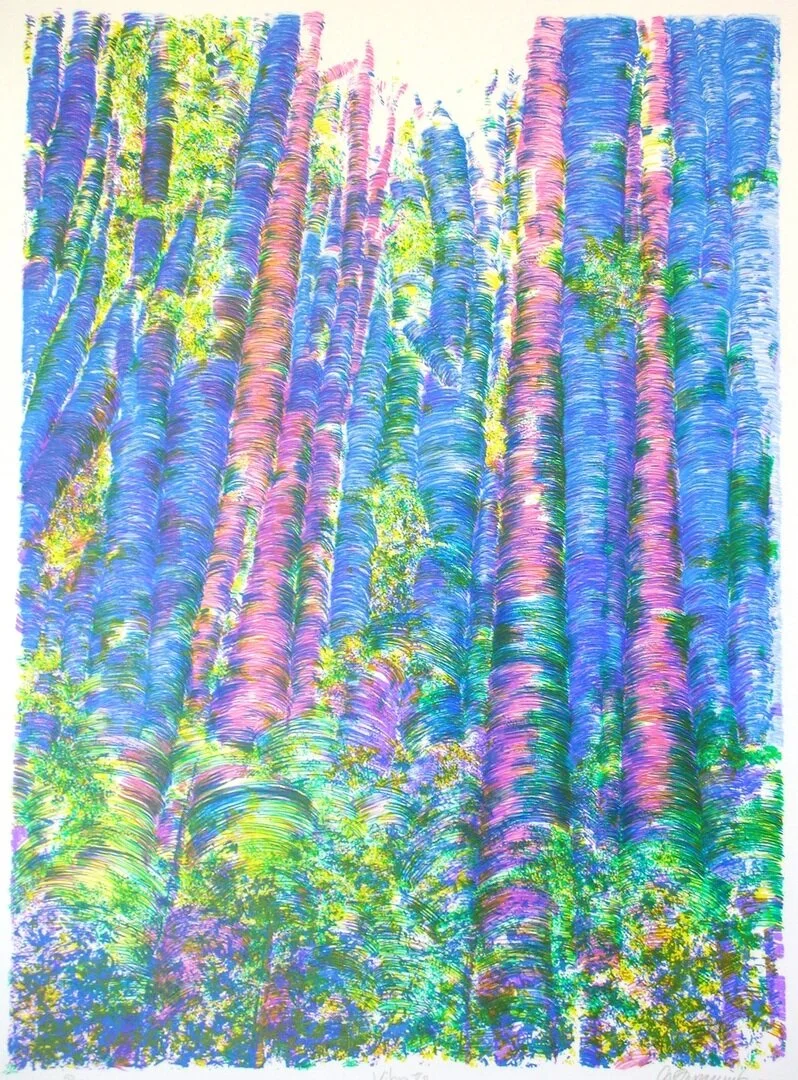
Juan Tallackson
Juan Rosillo Escuela, 2013
Drypoint
Ppr Size: 11 7/8" X 9"
Img Size: 6 7/8" X 4 7/8"
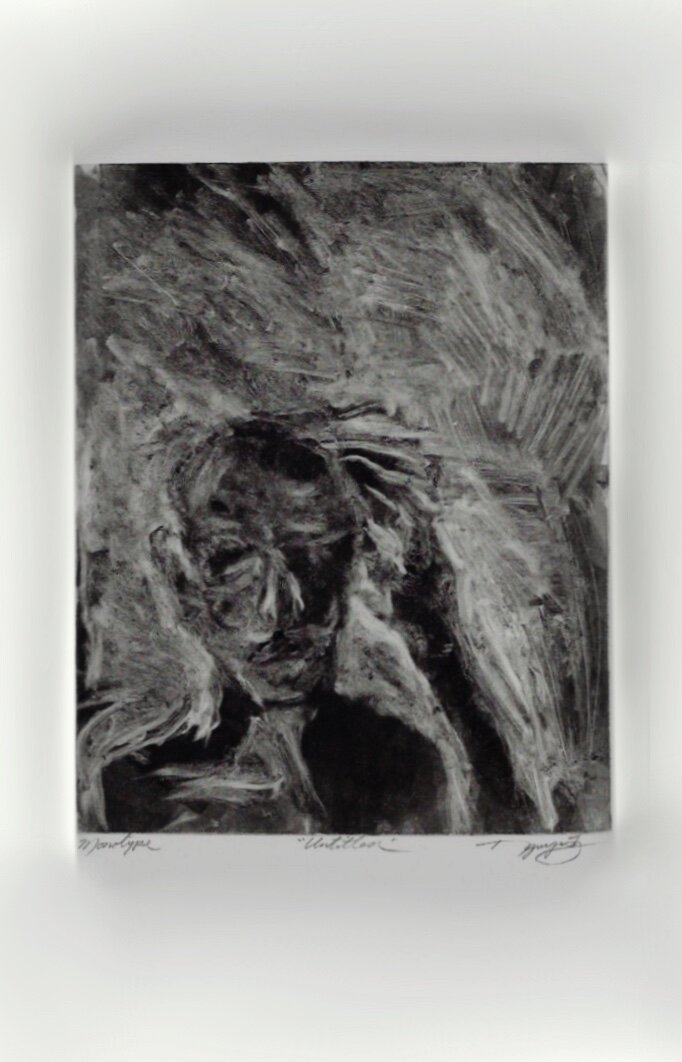
Nguyen Ly
Untitled (Man in Haze)
Monotype
Ppr Size: 14 13/16" x 11 1/8"
Img Size: 9 7/8" x 7 13/16"


William Borges Villarta
Yembo, 2008
Ppr Size: 16 5/8"x 15 1/2"
Img Size: 13 5/8" x 14 3/4"

Floating on Cotton: Freedom Maps, Trade Routes, and City Codes is Zoe Blaq's solo exhibition catalog that chronicles her artistic process and the distinctive features of her work as Self Help Graphics & Art's Beyond the Press artist in residence.
Floating on Cotton explores the interconnectedness of culture, identity, and the natural environment, delving into the rich historical context of Afro-Indigenous peoples. The exhibition illustrates migratory patterns, a quest for safety, resources, and cultural preservation through symbolic maps, rusted iron rods, baby's breath, old trinkets, and weathered wood. Blaq's work reflects the past and brings viewers to the present, engaging them in today's continued pursuit of housing, food security, and environmental sustainability.
In partnership with Art Share LA, the exhibition ran from December 8, 2024, through February 8, 2025. Funding was made possible by The Mike Kelley Foundation for the Arts and the California Arts Council.